
Look at the whole route, not one leg
A container shipment has three legs: from the shipper to the port of loading, the ocean leg, and from the port of discharge to the consignee. Quotes often compete on the middle leg. The total depends on all three, plus the time the container spends between them.
For each routing option, add up:
- ocean freight and surcharges to that port of discharge;
- terminal handling at that port;
- the inland leg from that terminal to your door, by the mode you will actually use;
- free days at that terminal and the expected dwell.
Port choice
On many deep-sea services to North-West Europe, the main ports of call include Rotterdam, Antwerp-Bruges, Hamburg and Bremerhaven. For a consignee in, say, western Germany, more than one of these can be a sensible port of discharge. The cheaper ocean rate to one port can be outweighed by a longer or more expensive inland leg, or by fewer free days at that terminal. Ask for quotes to more than one port when your final destination is inland.
Direct call or transhipment
Direct: the deep-sea vessel calls at both the port of loading and the port of discharge. One load, one discharge.
Transhipment: the container is discharged at a hub and loaded onto another vessel, often a smaller feeder, to reach its final port. That means an extra lift and an extra connection.
| Direct call | Transhipment | |
|---|---|---|
| Handlings | Load and discharge only | Additional discharge and reload at the hub |
| Connection risk | None | Container can miss its planned connecting vessel |
| Service choice | Limited to carriers calling both ports | More sailings and carriers |
Neither is cheaper by rule. When a transhipped quote is lower, ask what the routing is and how long the planned connection is.
The inland leg from Rotterdam
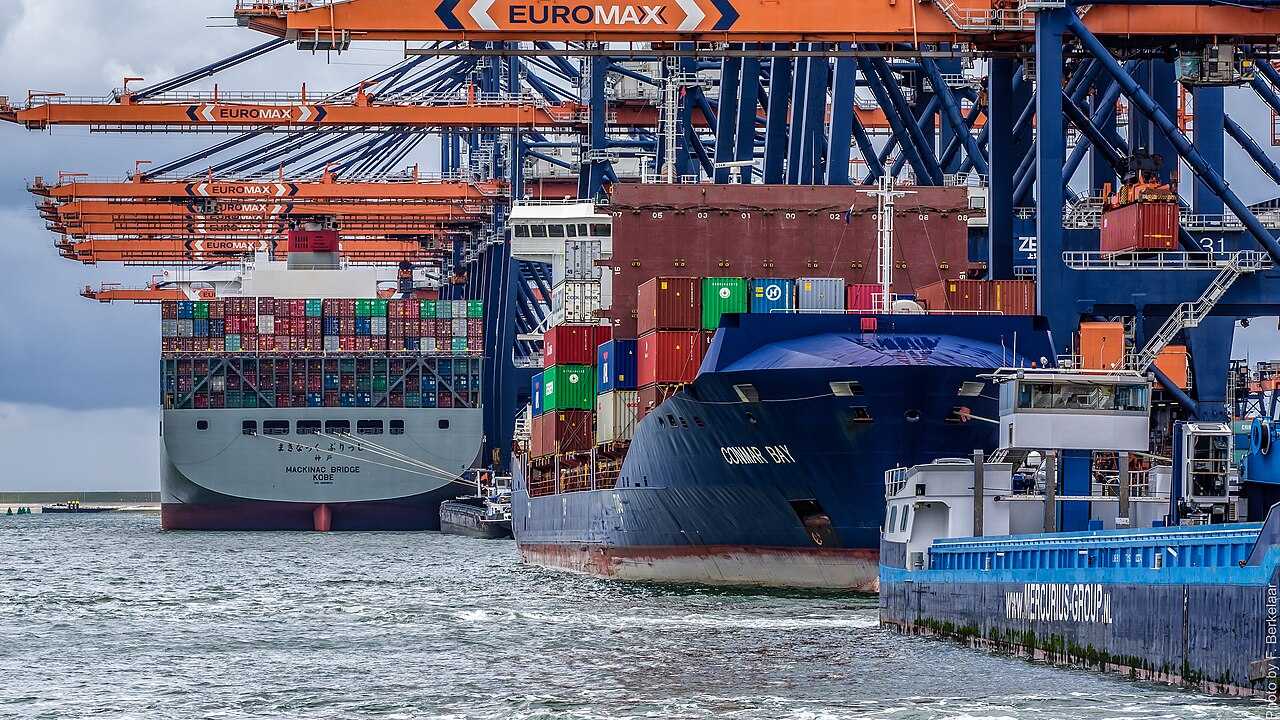
Rotterdam’s deep-sea container terminals on the Maasvlakte (including APM Terminals Maasvlakte II, Rotterdam World Gateway, ECT Delta and Euromax) connect to the hinterland by road, inland waterway and rail. The photo above shows all three ship types at one terminal: a deep-sea vessel, a feeder and an inland container barge.
| Mode | Suits | Watch for |
|---|---|---|
| Truck | Short distances, urgent loads, door delivery, single containers | Road weight limits, waiting time at the terminal, driver hours |
| Inland barge | Regular flows along the Rhine and Dutch and Belgian waterways to inland container terminals | Longer transit, last-mile truck from the inland terminal, water levels on the Rhine |
| Rail | Longer distances to inland terminals across Germany and Central and Eastern Europe | Fixed timetables and cut-offs, last-mile truck from the rail terminal |
Barge and rail usually end at an inland terminal, so the comparison is barge or rail plus a short truck leg, against a truck directly from the port. Inland terminals can also offer customs clearance and empty return, which can shorten detention and avoid a separate trip back to the port.
Carrier haulage or merchant haulage
- Carrier haulage: the shipping line arranges the inland transport and includes it in the transport contract.
- Merchant haulage: you or your forwarder arrange the inland transport.
Under both, the container still belongs to the carrier, so detention runs until it is returned empty (import) or delivered full to the terminal (export). Compare the two on price, free time and the empty return location.
Practical routing checklist
- Ask for quotes to at least two ports of discharge if your destination is inland.
- Ask whether the service is direct or transhipped, and where.
- Price the inland leg by each available mode, including the last-mile truck.
- Check free days at each terminal and whether inland empty return is allowed.
- Book barge or rail slots early; they run to timetables.
Questions
- Is a transhipment service always cheaper than a direct call?
- No. It can be, because hub-and-feeder networks offer more departures, but each extra lift adds a handling and a chance of the container missing its connection. Compare total cost and reliability, not the rate alone.
- Can I return an empty container at an inland terminal?
- Often, when the carrier accepts that terminal as an empty depot. It shortens the haulage and the detention period. Confirm the return location before the container is collected.
Reduce your container transport costs
Send your lane, container type and quantity to ContainerBooking.com, the Rotterdam booking desk that operates this site. You review the quote before anything is booked.